ROBO SUMO
🎯 Overview
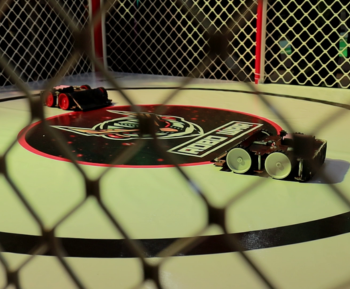
- In Robo Sumo, student-built robots face off in a high-energy showdown to push their opponents out of the arena. It’s a test of mechanical strength, coding logic, and strategic design, encouraging students to think like engineers and innovators.
👥 Team Composition
- Each team may consist of 1 to 3 members.
- Open to Grades 6 to 12.
- Only one robot is allowed per team.
- Teams must design and build their own robots — ready-made or pre-built robots are strictly prohibited.
🤖 Robot Specifications
1. Size
- The robot must fit within a 30 cm × 30 cm × 60 cm (height) box at the start of the match.
- It must remain a single centralized unit during the match.
- Robots violating this rule will forfeit the match.
⚠️ Exception : Loose parts (e.g., screws, nuts, etc.) with a combined mass of less than 5 grams falling off during the match do not result in disqualification.
2. Weight
- Maximum weight: 7 kg (including the battery).
- A 5% tolerance is allowed (up to 7.35 kg).
3. Power Supply
- Only Li-Ion or Li-Po batteries are permitted.
- Batteries must be securely mounted and properly insulated.
- Maximum operating voltage: 12V DC.
⏱️ Control System
- Robots must be manually controlled, as verified by tournament officials.
- Remote-controlled robots must:
- Start only on the referee’s official signal.
- Use digitally paired systems (e.g., Bluetooth, Wi-Fi, Flysky).
🏟️ Field and Match Format
- Matches will be conducted in a circular sumo ring (dimensions as specified by the organizers).
- A robot wins by pushing its opponent completely outside the ring.
- The match begins upon the referee’s signal.
🧾 Markings and Identification
- Each robot must have a visible top marker or unique identification tag.
- Robots without proper identification will not be allowed to compete.
📍 Mobility Requirements
- Robots must be capable of moving in any direction.
- Robots restricted to only linear (forward/backward) movement are not permitted.
🛠️ Build and Materials
Any mechanical or electronic components may be used as long as:
- The robot adheres to all rules and safety guidelines.
- The design and construction are original and not from commercial or pre-assembled kits.
⚖️Judging and Refereeing
- All matches will be supervised by event referees.
- Referees may inspect and test robots before or during matches.
- The referee’s decision is final and binding.