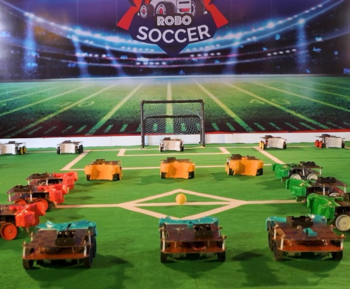
ROBO SOCCER - HEAVY WEIGHT
🎯 Overview
- Robo Soccer is an action-packed challenge where student-built robots compete to score goals using intelligent programming and design. It fuses robotics, coding, and teamwork, teaching precision, control, and strategic thinking in a fun, competitive environment.
👥 1. Team Composition
- Each team can have a a maximum of 5 players
- Open to students from Grade 6 to Grade 12.
- Each team must consist of 3 remote-controlled robots:
- 1 Goalkeeper – must remain inside the penalty box.
- 2 Strikers – free to move throughout the field.
🤖 2. Robot Specifications
- Size: Each robot must fit within a 30 cm × 30 cm × 30 cm box.
- Weight: Maximum weight is 7 kg, with a ±5% tolerance (up to 7.35 kg).
- Identification: Robots must be marked as 1 2 3 or A B C
- Control: Robots must be controlled wirelessly using:
- Bluetooth, Wi-Fi, or RF/RC modules.
- Restrictions:
- No sensors of any kind (e.g., IR, ultrasonic, cameras, etc.) are allowed.
- All movements and decisions must be made manually by the human controller via remote.
⚽ 3. Soccer Ball
- The ball will be a 40 mm diameter ping pong ball or a 3D-printed ball (preferably orange or white).
🏟️ 4. Field Specifications
- Field Size: Recommended size is 2.4 m × 1.5 m, featuring:
- Clearly marked boundary lines
- Penalty boxeson both ends
- Goal Area: Clearly visible and defined; only the goalkeeper may remain inside their team’s penalty box.
⏱️ 5. Match Duration and Structure
- Total Duration: Each match lasts 7.5 minutes, divided into
- Two 3-minute halves
- 1.5-minute break between halves
- Robot Repair Time:.
- Teams may use the 1.5-minute break to repair damaged robots.
- No additional repair time is allowed during active play.
🧾 6. Gameplay Rules
- Kick-off:Decided by coin toss at the start of the match.
- Goalkeeper Rule: Must stay within the penalty box at all times.
- Violations result in a warning, and repeated offenses may lead to a free kick for the opponent.
- Ball Possession
- If Team A kicks the ball out of bounds, Team B is awarded possession from the sideline.
- Ball Hoarding: Robots cannot trap or hold the ball for more than 5 seconds.
- Robot Damage:
- If a robot becomes damaged, it may be removed from play.
- The goalkeeper may take a striker’s role, and the team may continue with two robots.
🏆 7. Scoring and Tie-Breakers
- A goal is valid only if the entire ball crosses the goal line.
- After each goal, the non-scoring team restarts from the center.
Tie-Breaker Rules:
- League Matches:
- If tied, each team gets 3 penalty kicks.
- If still tied, the winner is decided by a coin toss.
- Semi-Final & Final Matches:
- If the game ends in a tie, 1 minute of extra time will be provided.
- If tied after 3 penalties, the match continues with a Golden Goal (first to score wins).
⚖️ 8. Fouls and Penalties
- Illegal Contact: Intentional damage or ramming is strictly prohibited.
- Unsportsmanlike Conduct: May lead to immediate disqualification.
- Out-of-Bounds Play: The team that kicks the ball out loses possession.
🔋 9. Power and Communication
- Power Supply:
- All robots must be battery-operated.
- No wired power connections are allowed during matches.
- Communication:
- Robots must be controlled via Bluetooth, Wi-Fi, or RF modules.
- Autonomous or sensor-based actions are strictly prohibited.
🧍 10. General Conduct
- All robots must pass pre-match inspection for compliance.
- Teams must respect referees, opponents, and event coordinators.
- Referee decisions are final and binding.