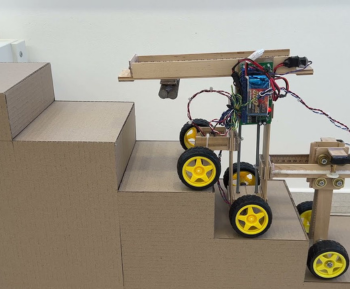
STAIR CLIMBING ROBOT
🎯 Overview
- In this event, participants design robots capable of climbing stairs or uneven surfaces with balance and stability. The challenge tests mechanical design, motor coordination, and control algorithms, encouraging students to think critically about motion dynamics and engineering precision. It’s where innovation meets elevation!
👥 Team Composition
- Each team may consist of up to 3 members
- Only one robot per team is permitted
- Open to students from Grade 6 to Grade 12.
- Mentors are not allowed to interfere during active runs.
🤖 Robot Specifications
1. Dimensions
- Maximum size: 60 cm × 30 cm × 30 cm (length × width × height).
- Robots will be verified before the event and must fit within the inspection box.
2. Power Supply
- Robots must be battery-powered.
- Allowed battery types: Li-Ion or Li-Po.
- Maximum voltage: 12V.
- Batteries must be securely mounted and insulated.
3. Control System
- Robots can be:
- Manual → Controlled via Bluetooth, PS3 joystick, or wireless transmitter/receiver.
- Autonomous → Fully self-navigating using programmed logic
- Control type options:
- Programmable (microcontroller-based, e.g., Arduino, ESP32, Raspberry Pi Pico) using only BO or DC gear motors.
- Non-Programmable (wired/wireless control without coding) using only BO or DC gear motors.
4. Mobility
- Maximum of 6 motors allowed.
- Robots must support:
- Forward and backward motion
- Left and right turns
5. Prohibited Elements
- No OG555, Johnson, or BLDC motors.
- No readymade stair-climbing kits or pre-built models.
- No hazardous or unsafe materials.
🏟️ Game Setup
- The arena will feature a variety of stair structures, including:
- 1. Standard Steps – Up to 10 steps, maximum height 6 inches each.
- 2. Irregular Steps – Uneven widths and heights
- 3. Inclined Ramps – Combined with stairs
🧾 Scoring Criteria
- 1. Time Taken – Faster completion earns higher points.
- 2. Successful Climbing – Points awarded for each step completed without falling.
- 3. Base Time – Total Time taken by the robot to reach top of the staircase.
- 4. Bonus Time – – For each stair climbed successfully on the first attempt, a bonus time will be deducted from the final time as follows:
- Autonomous Mode: -2 seconds per Stair
- Manual Mode: -1 seconds per Stair
This reward encourages smooth and efficient climbing performance.
⚖️ Penalty Time
If the robot falls down or is touched by the player during the run, a time penalty will be added to the final time as follows:
- Manual mode: +5 seconds
- Autonomous mode: +2 seconds
- This rule ensures careful operation and stability during the run.
Final Time Calculation
- Final Time = Base Time + Total Penalty - Total Bonus
📋 Competition Rules
- Matches will have a fixed time limit.
- Technical inspection of all robots before the event is mandatory.
- Robots must start at the designated starting point.
- Limited repair time may be allowed if a robot malfunctions.
- No modifications are allowed during an active run.
- Referee/judge decisions are final and binding.
- Any unsportsmanlike behavior will result in disqualification.
🔒 Safety Requirements
- Robots must not use flammable, toxic, or hazardous materials.
- A safety check will be conducted before matches.
- Robots must be easily stoppable by officials at any time.
- Teams are responsible for the safe operation of their robots.
👥 Team Conduct Expectations
- Teams must show respect toward mentors, referees, and fellow participants.
- Robots must not intentionally damage arena setups.
- Teams should manage time and resources effectively
- Professional handling of equipment is expected.
- Teams must maintain a clean workspace after the event.