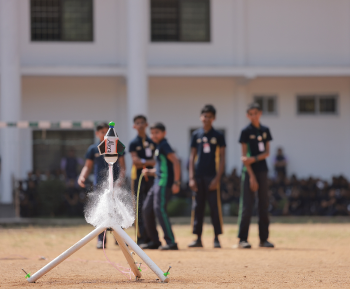
WATER ROCKET
🎯 Overview
- In this challenge, participants design and launch water-powered rockets using principles of physics, pressure, and propulsion. It’s an exciting hands-on activity that blends STEM learning with creativity, teaching students about energy, design, and precision.
🛠️ Rocket Design Requirements
- The rocket must be made primarily from plastic bottles (e.g., PET bottles).
- Only water and air pressure may be used as propellants.
- No other propulsion methods (chemical, electric, combustion, etc.) are allowed.
- Mechanical launching ideas are allowed.
- The rocket may include fins and a nose cone for improved stability.
- A parachute is mandatory for safe descent.
- Maximum rocket length: 1.5 meters.
- Hazardous or unsafe materials are strictly prohibited.
👥 Team Composition
- Maximum of 2 members per team.
- Categories:
- Grade 4 to 7 – Category 1
- Grade 8 to 12 – Category 2
📍 Launch Area & Setup
- The launch area will be designated on the event day
- Teams must bring their own rockets, launch setup (if required), and accessories.
- All rockets will be inspected to ensure compliance with safety and design regulations.
🎯 Performance Categories
1. Air Time Category
- Rockets are scored based on the total air time from launch to first contact with the ground.
- Each team will have two launch attempts.
- The best air time will be considered for scoring.
- After launch, the rocket must deploy its parachute and descend safely.
- The rocket must land within the designated launch field boundaries.
- Any rocket that lands outside the competition area will be disqualified.
2. Design & Creativity
- Teams will also be evaluated on innovation, structure, stability, and presentation of their rocket.
📋 Scoring Criteria
| Criteria | Weightage |
|---|---|
| Design and Innovation | 10% |
| Launch Performance (Air Time) | 30% |
| Rocket Stability and Accuracy | 10% |
⚠️ Disqualification Conditions
- Launching before the official signal.
- Using unapproved materials or methods (e.g., chemical fuels, electronics).
- Unsafe or irresponsible behavior during the event.
- Failure to comply with size, safety, or registration requirements
🕐 Event Flow
- Each team will have two launch attempts
- Water volume and air pressure may be adjusted between attempts.
- A brief explanation (2–5 minutes) is required before each launch (subject to referee’s discretion) covering:
- Design choices
- Launch mechanism
- Safety considerations
- Expected performance